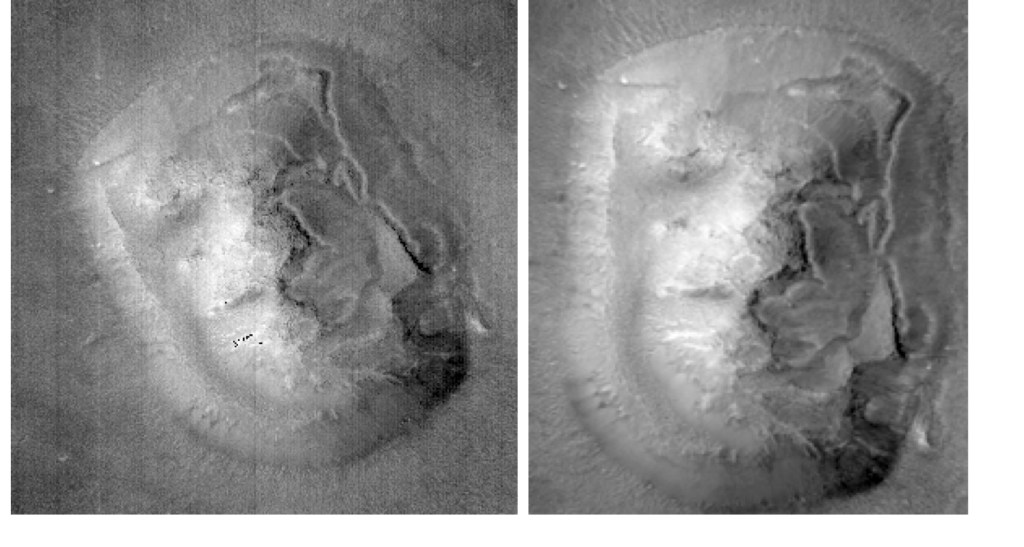
Following our AGU presentation it was difficult to publish any new results in scientific journals as the establishment had evidently made up its mind. Even alternative venues such as the Journal for Scientific Exploration (JSE), which had and has published numerous papers of mine, would not even consider a paper on the Face. In my rejection letter, its editor, Bernie Haisch wrote that “it would undermine the scientific credibility of the Journal to publish your claim about the new MGS image still supporting a face on Mars. It is way too big a stretch.”
On April 8, 2001, Mars Global Surveyor (MGS) was able for the first time to obtain a fully illuminated high-resolution image of the Face on Mars. Like previous MGS images, the Face appeared at first glance to be a highly eroded natural formation. However, analysis of this new image showed it to possess a very high degree of symmetry in two directions.
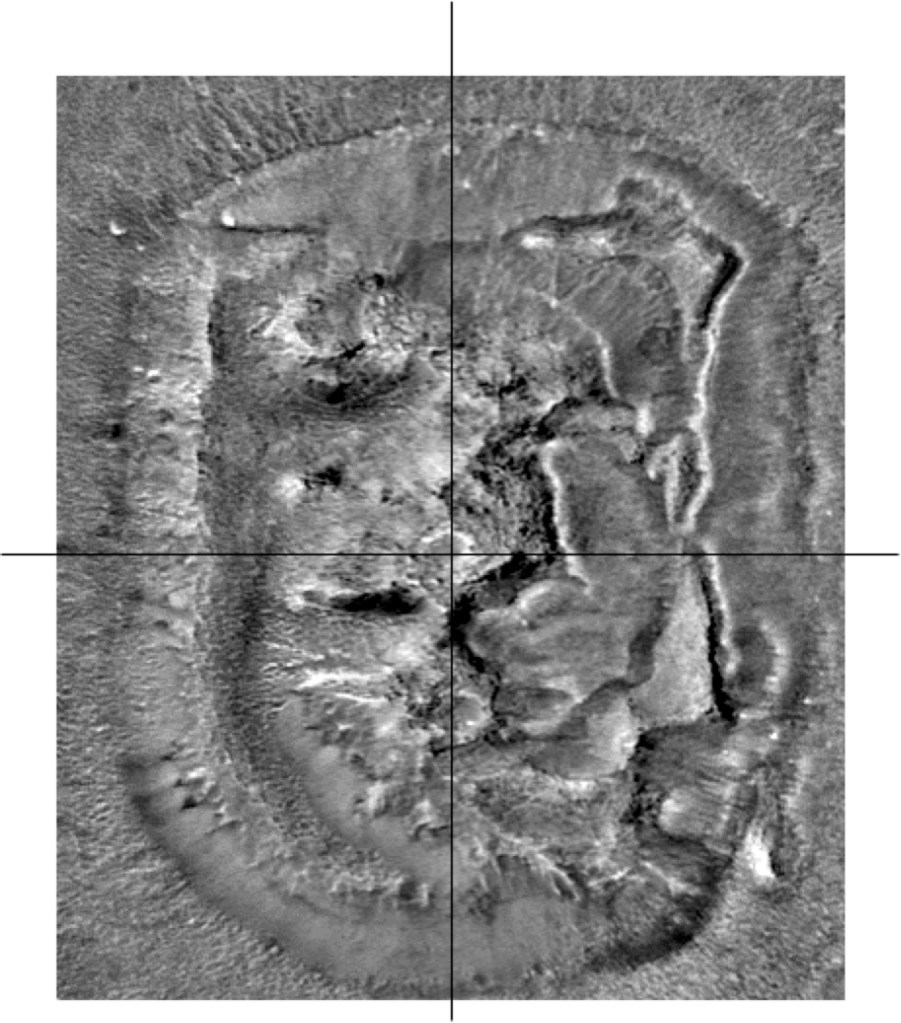
Orthorectified image with vertical and horizontal axes of symmetry shown. Note the two axes intersect at the center of a small circular depression. 
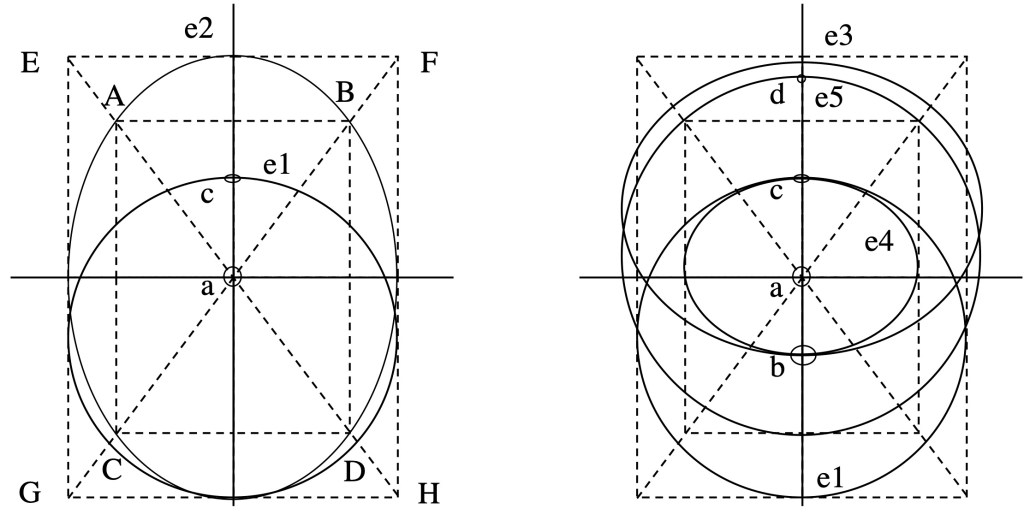
Geometrical construction of inner and outer 4-3 rectangles. 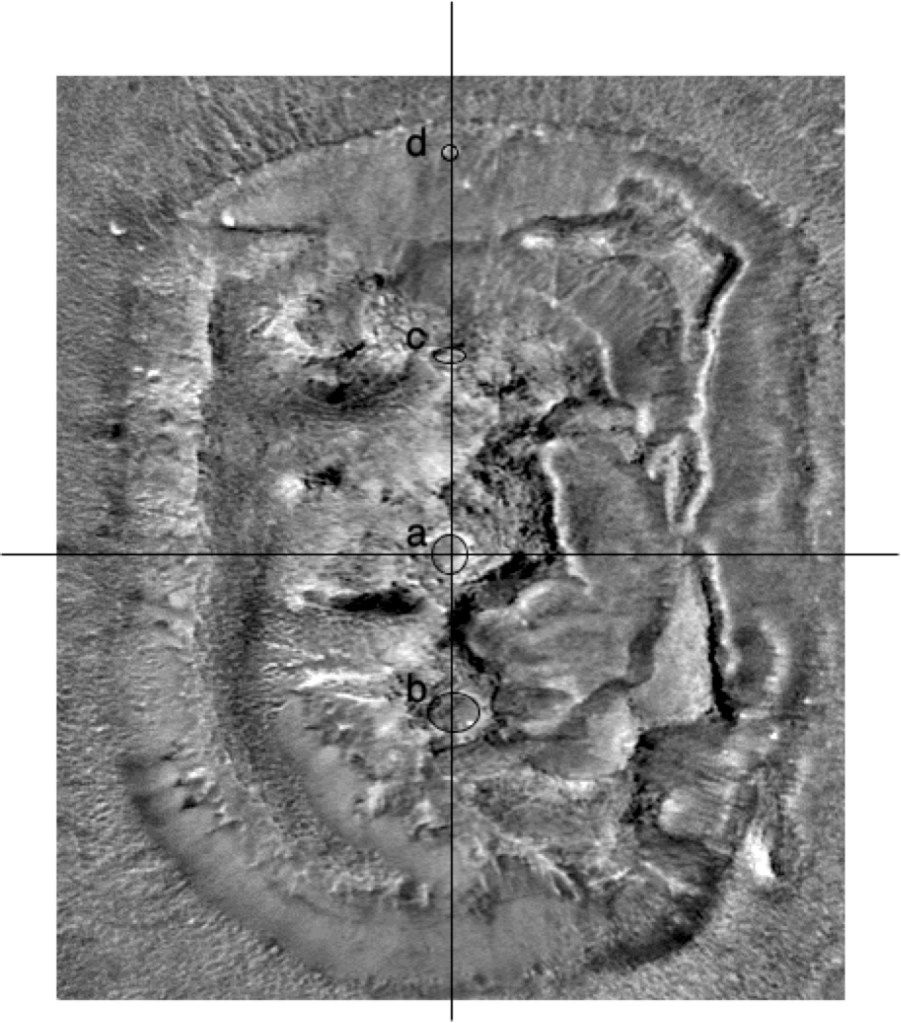
Four circular features (a-d) located along the lateral centerline (horizontal axis of symmetry). 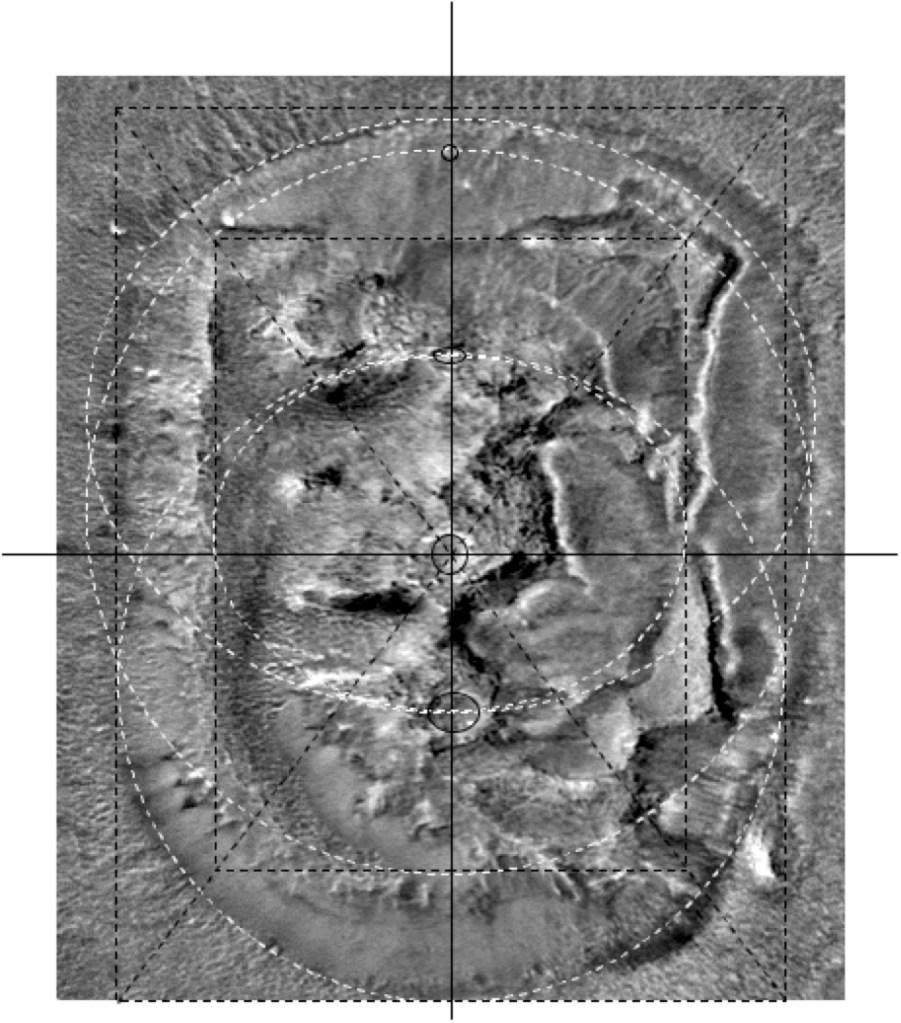
Additional support for 4-3 rectangles.
Using repeatable geometrical constructions based on clearly resolved features the Face also appeared to fit a consistently expressed geometrical model based on rectangles having a long-to-short side ratio of 4/3, i.e., by rectangles diagonally bisected by 3-4-5 right triangles.
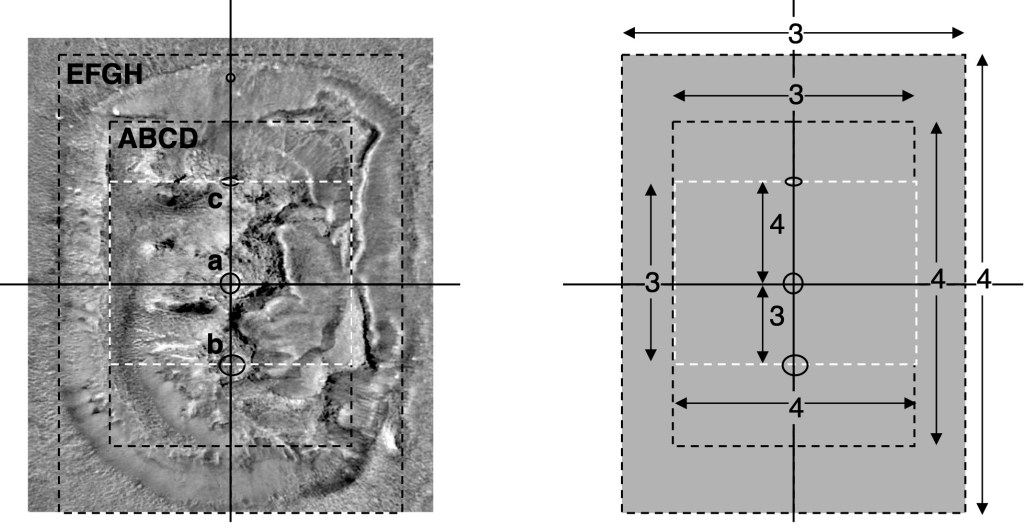
Analysis of the new image revealed that the right (east) side of the Face could be covered with sand. The depth of the sand appears to be sufficient to have covered over some of the detail on the east side and may account for its apparent lack of facial symmetry.

As remarkable as these new results were, no journal was willing to publish them. I decided to create an online journal, one of the first of its kind later that year. My friend Holiday Weiss designed and launched the new journal – New Frontiers in Science in the fall of 2001. An article reporting the new results was the first paper. (Click here to read a revised version of this paper.) The second article was an independent review of my paper by Horace Crater.
Professor Crater had published an analysis of the spatial distribution of mound-like features to the southwest of the Face in JSE a few years earlier. In his 1999 paper, Crater and co-author Professor Stanley McDaniel showed that a group of formations in the Cydonia area of Mars of relatively small and nearly uniform size have relative positions that repeatedly display symmetries in the apparent form of related right and isosceles triangles.
The structure of the Face on Mars appeared to be based on repeated instances of 3-4-5 right triangles. But was this evidence of architectural design or Mother Nature playing another trick on us? The new MGS image did not show obvious signs of artificiality along the lines of what Carl Sagan had outlined in a paper written thirty years earlier. Instead, it was more subtle, not unlike the appearance of some of the most ancient archaeological ruins on Earth.
 markcarlotto.com
Leave a comment