
In the late 1980s, I published the results of my analysis of the Face and other unusual features on Mars in several technical papers and a book. Released a few years after Richard Hoagland’s book, The Monuments of Mars, The Martian Enigmas examined these features in greater detail and presented a case for artificiality based not only on their appearance but also on their shape, structure, and context. Almost a half century after they were first imaged by a Viking orbiter spacecraft in 1976, this article briefly revisits these features with more recent higher resolution imagery.
The Face on Mars
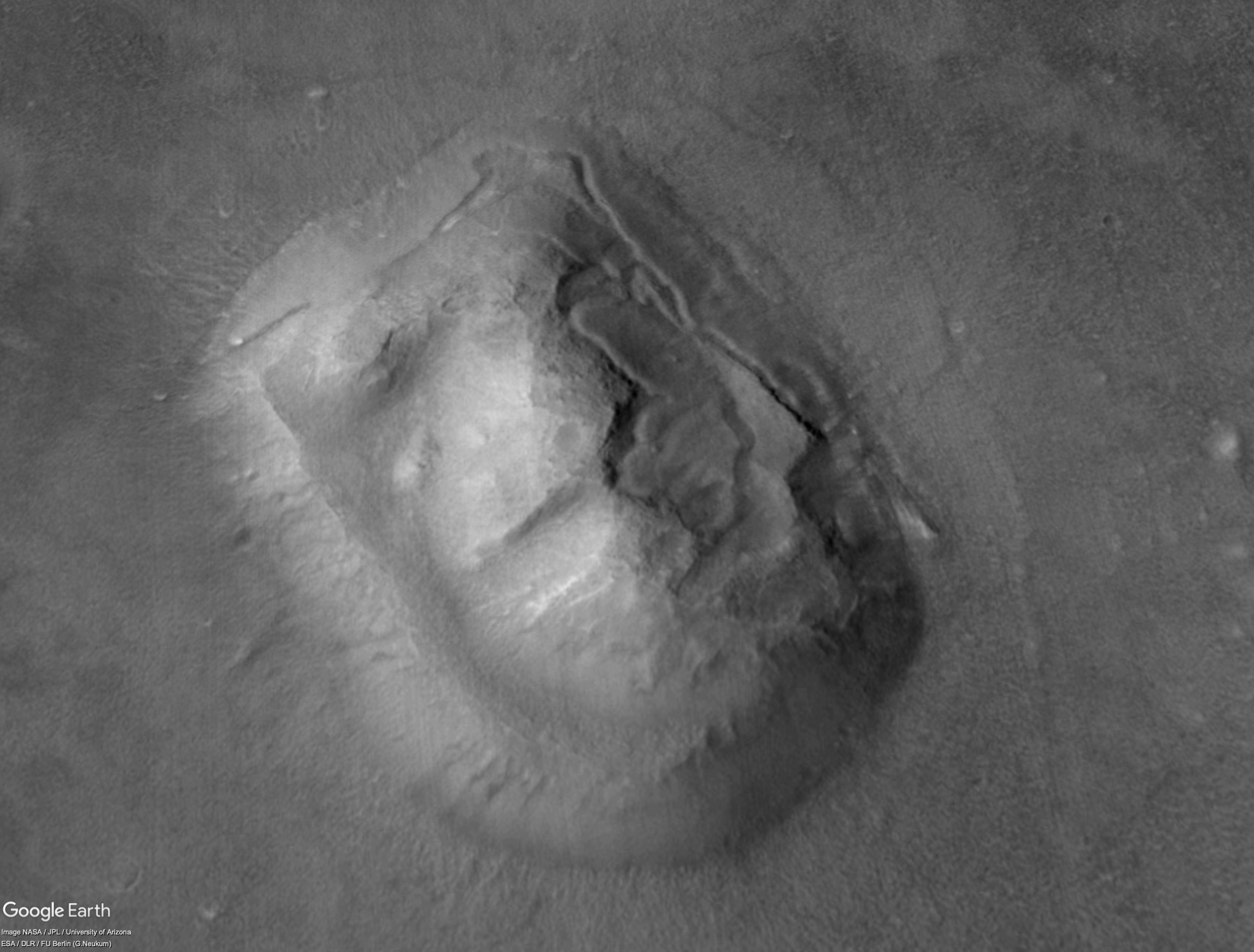
Starting with the infamous “Face on Mars,” this feature is clearly not as face-like in appearance as it was in the original Viking photos. However, higher resolution imagery reveals important details not evident in Viking frames 35A72 and 70A13.


Mars Reconnaissance Orbiter (MRO) context image (left) and restored and enhanced Viking orbiter images of the Face in 35A72 (top right) and 70A13 (bottom right). (NASA/JPL/ASU/Google Earth)
Analysis of higher resolution imagery indicates the Face could have once been a much more symmetrical structure that has become severely degraded by the Martian environment. Specifically, there is evidence of mass wasting on the right, shadowed side of the Face where material appears to have slid down and to the right as the result of wet-dry-freeze-thaw cycles or erosion at the base of the structure.


The location and spacing of features a–c establish the 4-3 rectangular geometry. The intersection of the horizontal and vertical axes of symmetry and the centers of rectangles A-B-C-D and E-F-G-H – both 4-3 rectangles – lie within a. The intersections of ellipses e1 and e3 which bound the edges at the base of the platform and the horizontal axis of symmetry fall inside c and b. The ratio of the center-to-center distances a–b/a–c is approximately 4/3 (to within 3%). These same two points of intersection within b and c together with rectangle A-B-C-D define another 4-3 rectangle which bounds ellipse e4.
The D&M Pyramid
Better imagery of this enigmatic structure, discovered by Vince DiPietro and Greg Molenaar, suggests that its geometry may not be five-sided as Hoagland proposed. Instead it is possible to represent its facets by simple triangles reflected roughly east-west along a horizontal axis of symmetry as shown below. Whether it is an artificial object or an example of what some call “enigmatic geology” remains to be determined.

THEMIS image of the D&M Pyramid. The presence of angles approximately at 30°, 60°, and 90° suggests that the faces of the D&M Pyramid can be described by isosceles and right triangular facets.
The Fort, Starfish Pyramid, and City Square
Hoagland’s “City” is a group of features west – southwest of the Face that appeared to be aligned in the same general direction.
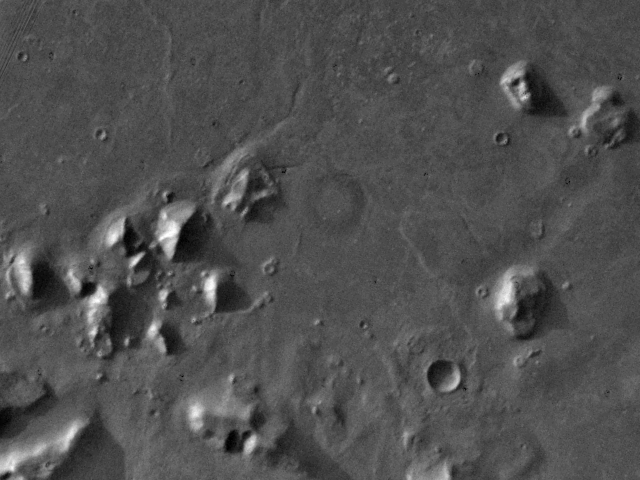
These features are admittedly not as remarkable when viewed close up in higher resolution imagery. Looking like naturally eroded landforms, there is nothing about them that seems to distinguish them from other features in the area.
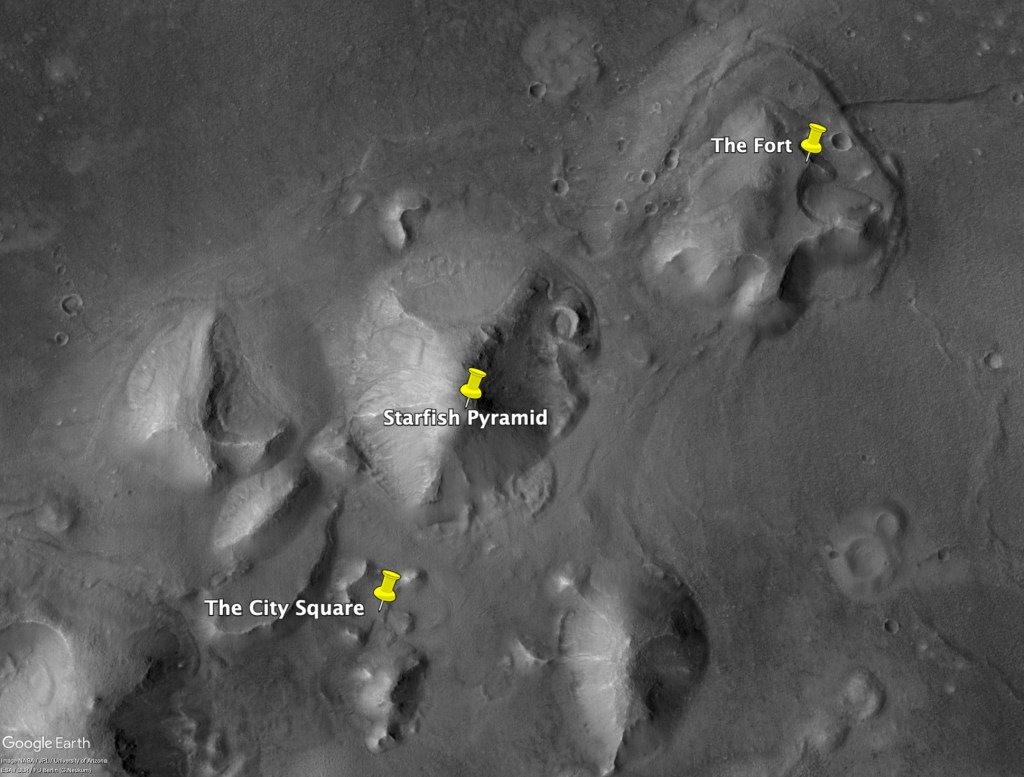
Other Features in Cydonia
Two structures known as The Bowl and B Pyramid, about 100 km southwest of the Face, seemed to reflect the organization and shape of the Fort and Starfish pyramid. But up close, they too are not remarkable.
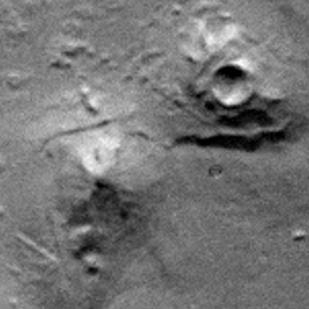
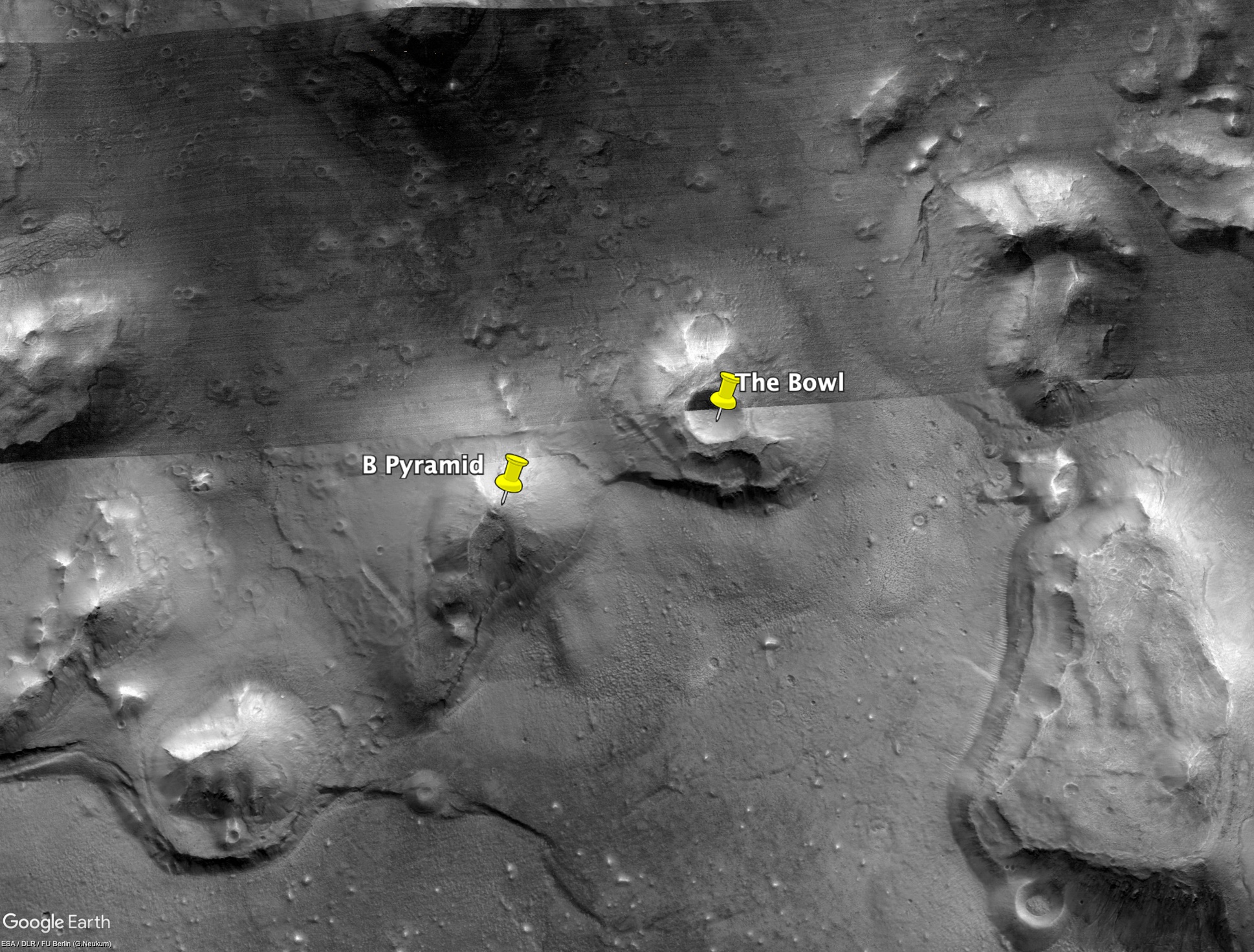
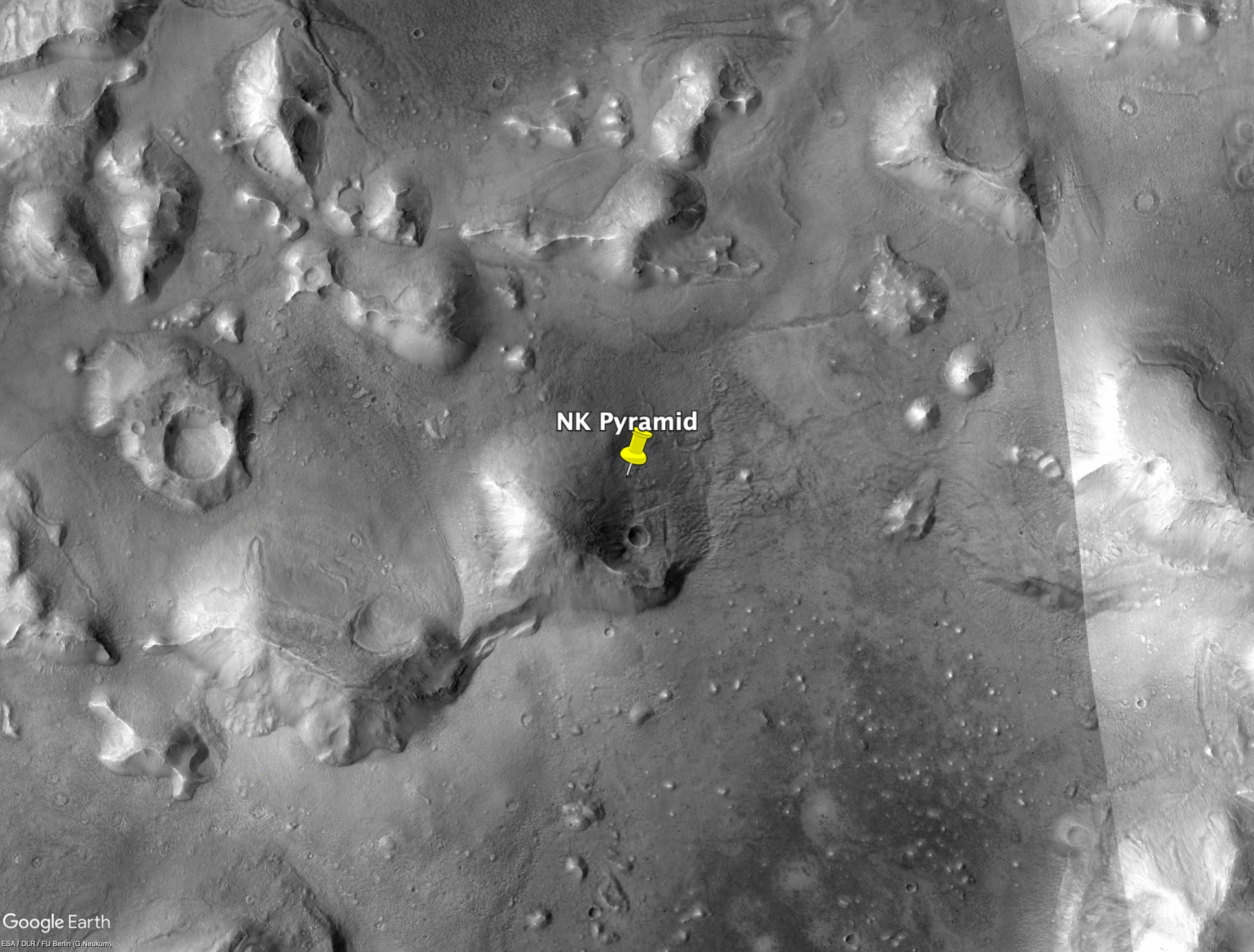
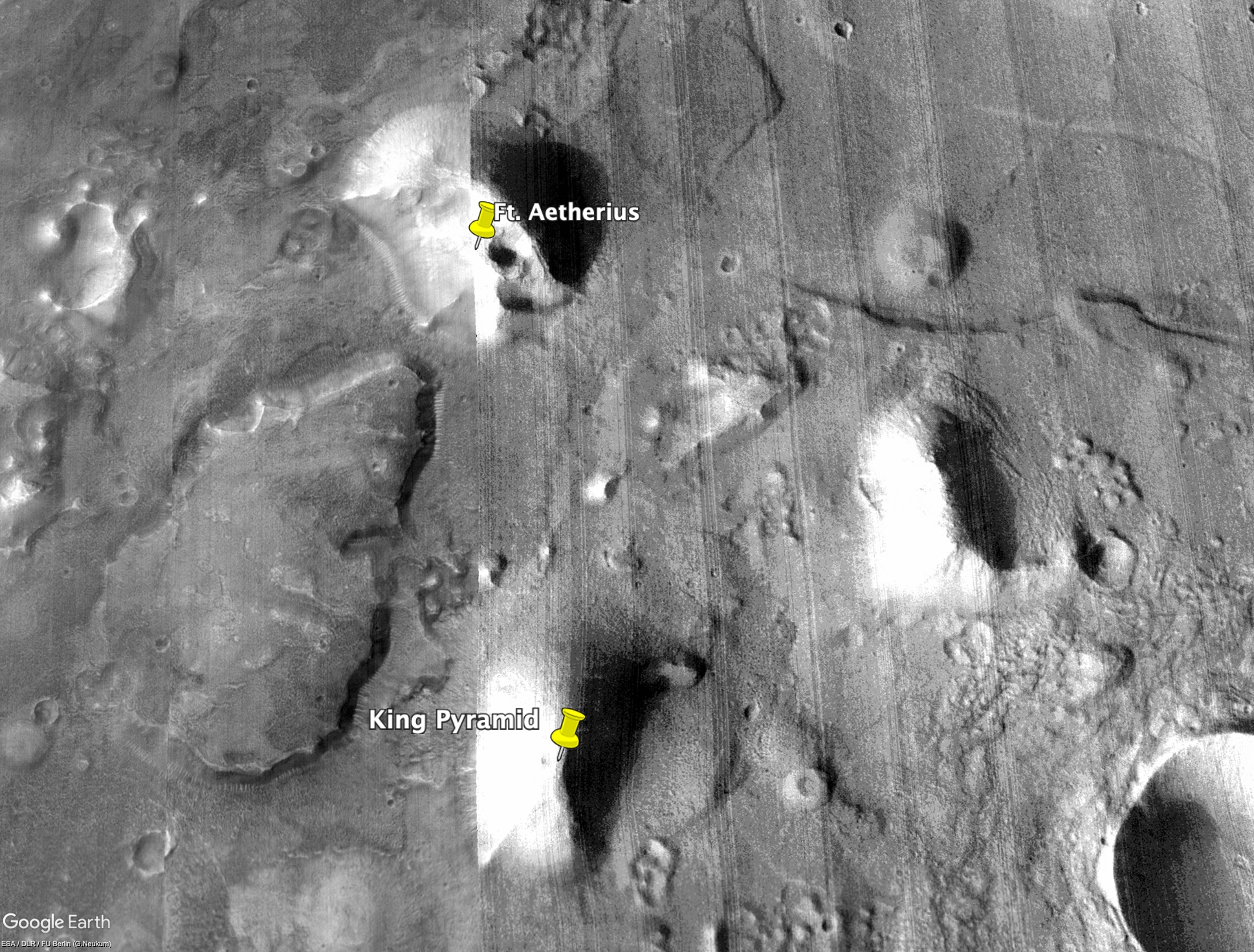
Chris O’Kane and students at the North Kelvinside school in Scotland discovered another pyramidal feature about 50 km west – southwest of the Face they called the NK Pyramid. Ananda Sirisena found two other features, which he named Ft. Aetherius and the King Pyramid that also seemed to resemble the Fort and Starfish pyramid. Again, up close these features appear to be natural.
The Crater Pyramid
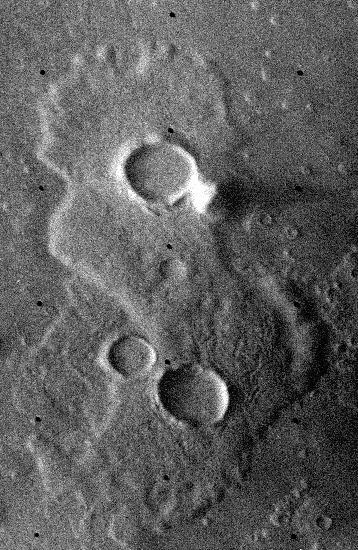
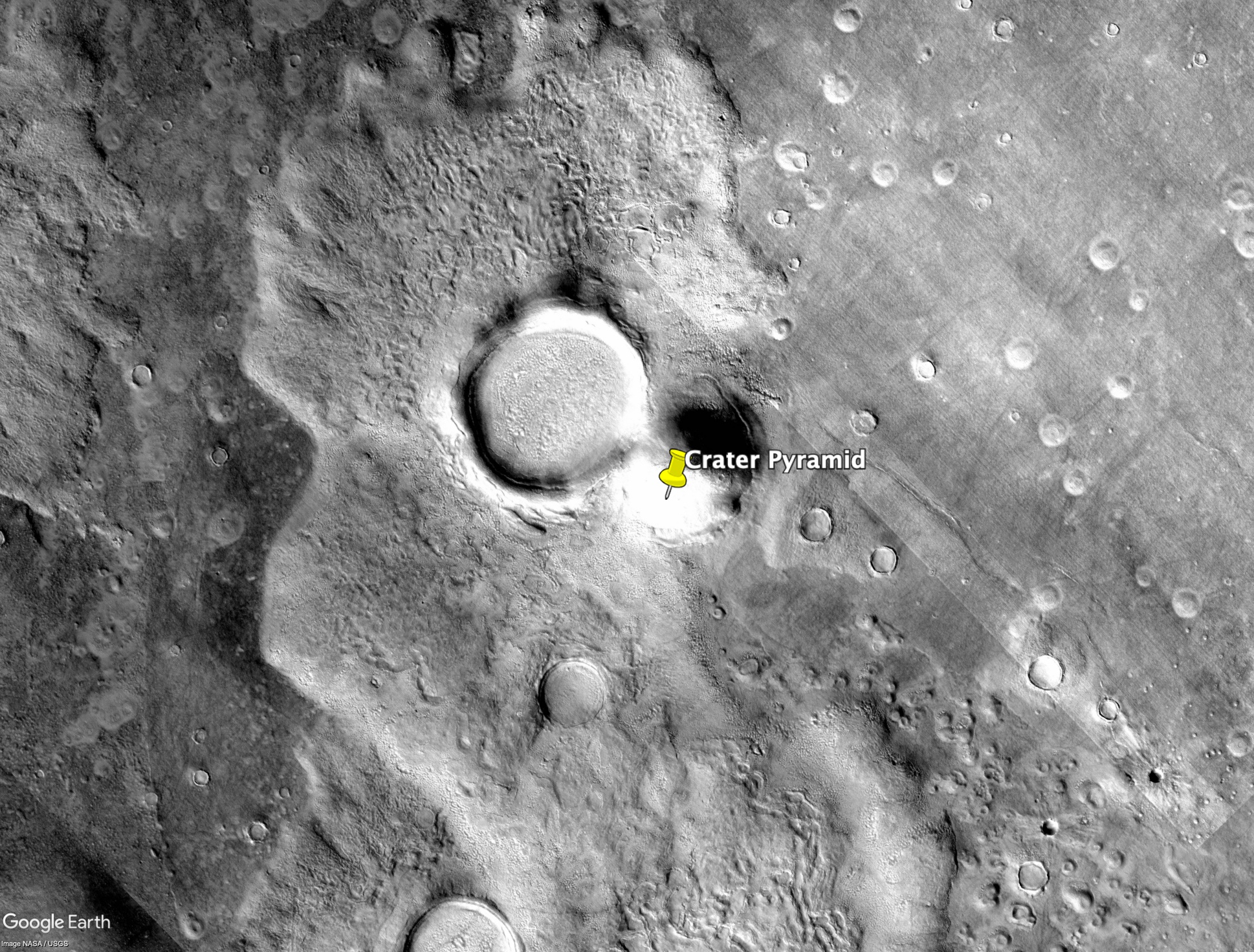
The presence of a pyramid at the edge of an impact crater seemed to be incontrovertible evidence of an artificial structure. Yet, close up, the Crater Pyramid found by John Brandenburg appears to be a natural formation. Still, its uniqueness compared to other craters and formations in the Deuteronilus region of Mars cannot be easily explained.
The Runway
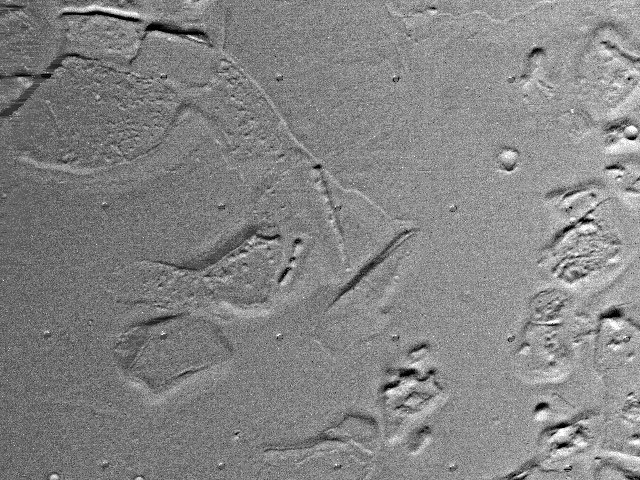
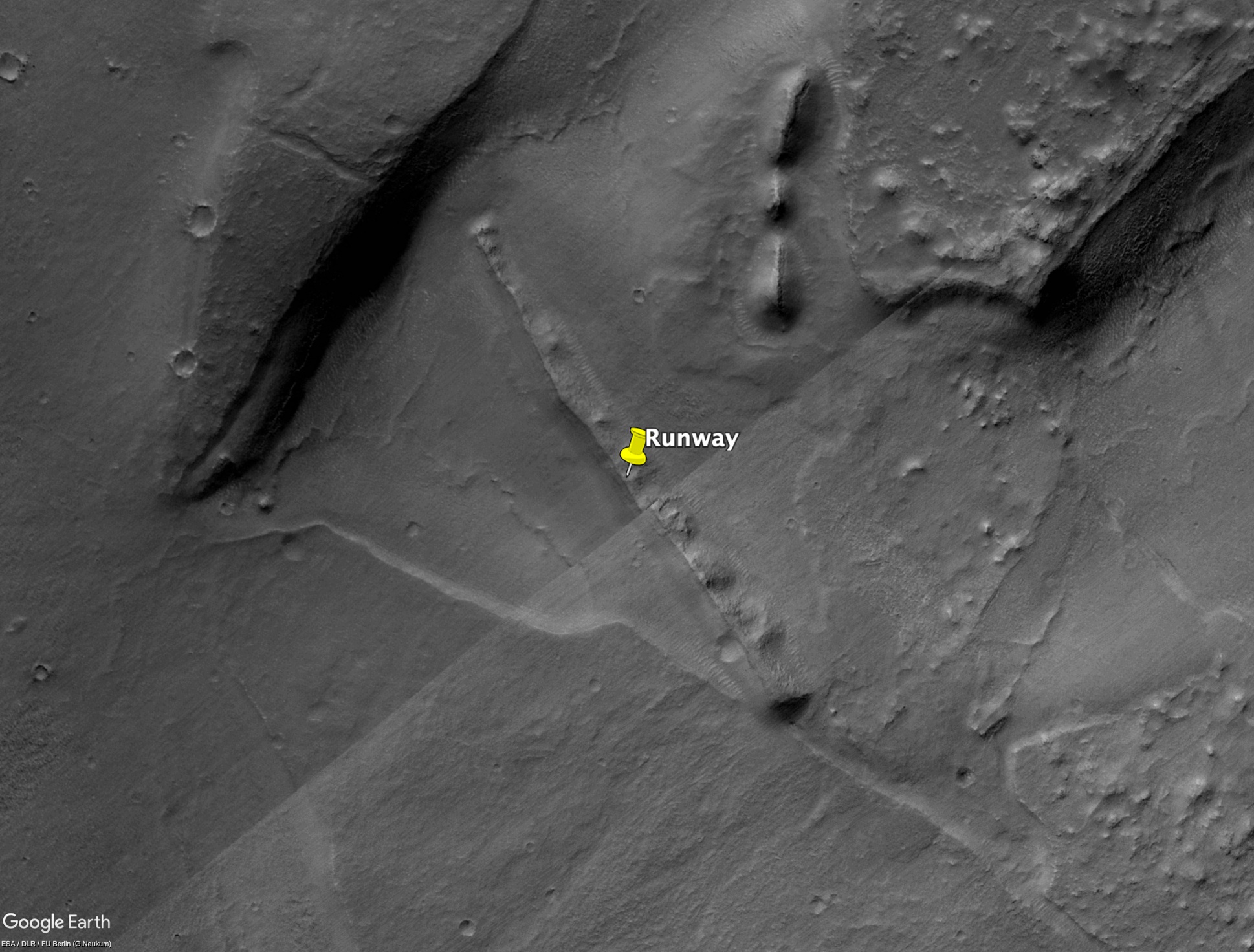
Originally imaged by the Viking orbiter this feature seemed exotic. Hoagland suggested it could be some kind of device (a rail gun?) for launching objects into space from the surface of Mars. However, up close, this feature west of Hecatus Tholus appears to be natural, perhaps volcanic in origin.
Conclusion
NASA/JPL has maintained these and other objects since discovered are natural surface features. Up close, some clearly seem natural while others like the Face, D&M, and possibly the Crater Pyramid remain enigmatic in one way or another. Future articles will report on more recent findings concerning these and other possible artifacts on Mars.
More
To examine these features using Google Mars, download this zip compressed kml file, extract the kml file, and then load it into Google Earth, which will automatically take you to Mars.
 markcarlotto.com
Leave a comment