
It has been suggested that an unusual square-shaped feature near the rim of an unnamed crater in the Arabia Terra region of Mars is a highly symmetrical object that might be an artificial structure of some kind. Further analysis of the surrounding imagery reveal additonal features in the crater floor that also look unusual. This article examines these features in order to understand why they look unusual, which relates to the question of whether they could be artificial.
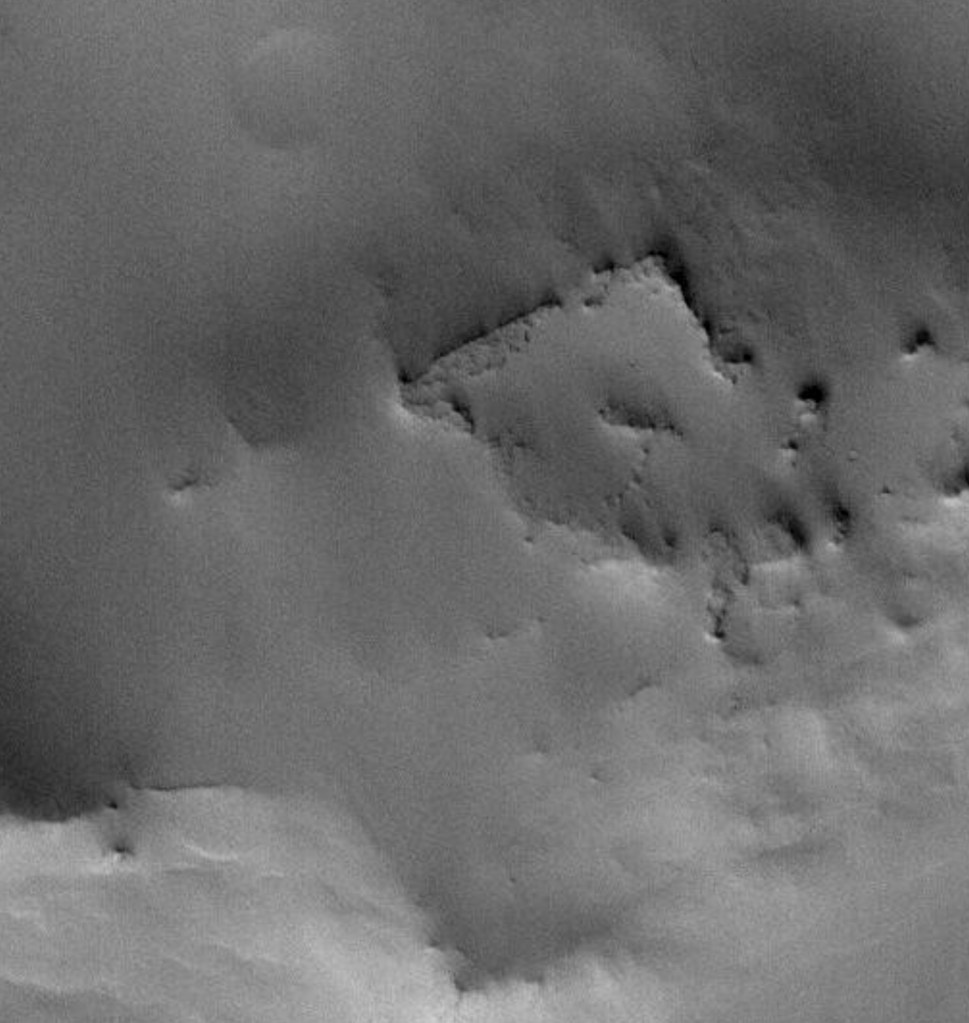
A square-shaped object (latitude, 27.601794° N and longitude, 27.826384° E) first discovered by Richard Hoagland is one of many, perhaps hundreds of surface features on Mars that look artificial. A variety of factors affect how we interpret unknown surface features in unfamiliar terrains. This article explores the effect of viewpoint, specifically the position of a satellite with respect to the surface feature.
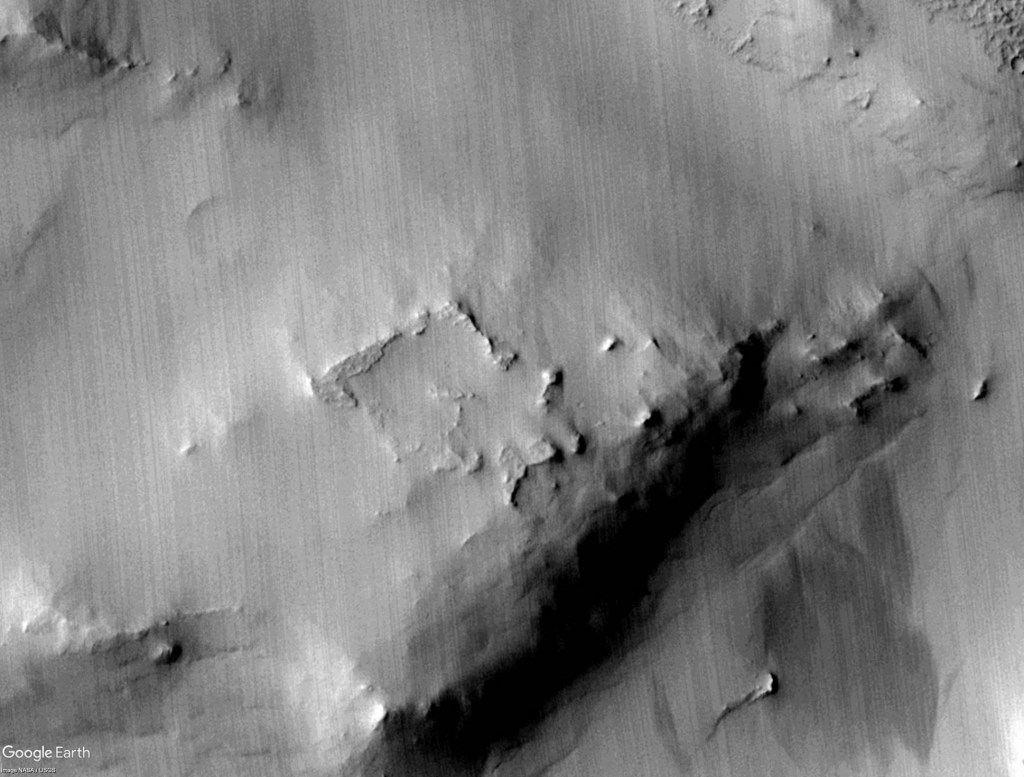
Foreshortening
Unless a satellite is directly overhead and looking straight down, an effect known as foreshortening alters the appearance of objects by changing the scale factor of the image and hence the size of the object in the scan direction.

Although the square formation is not a perfect square on the ground in Google Mars, it appears to be in the MOC image, and so, based on its apparent symmetry, could be interpreted as an artificial structure.

Context
Stepping back, if we examine the square formation within the surrounding area, it is not unlike other nearby features.
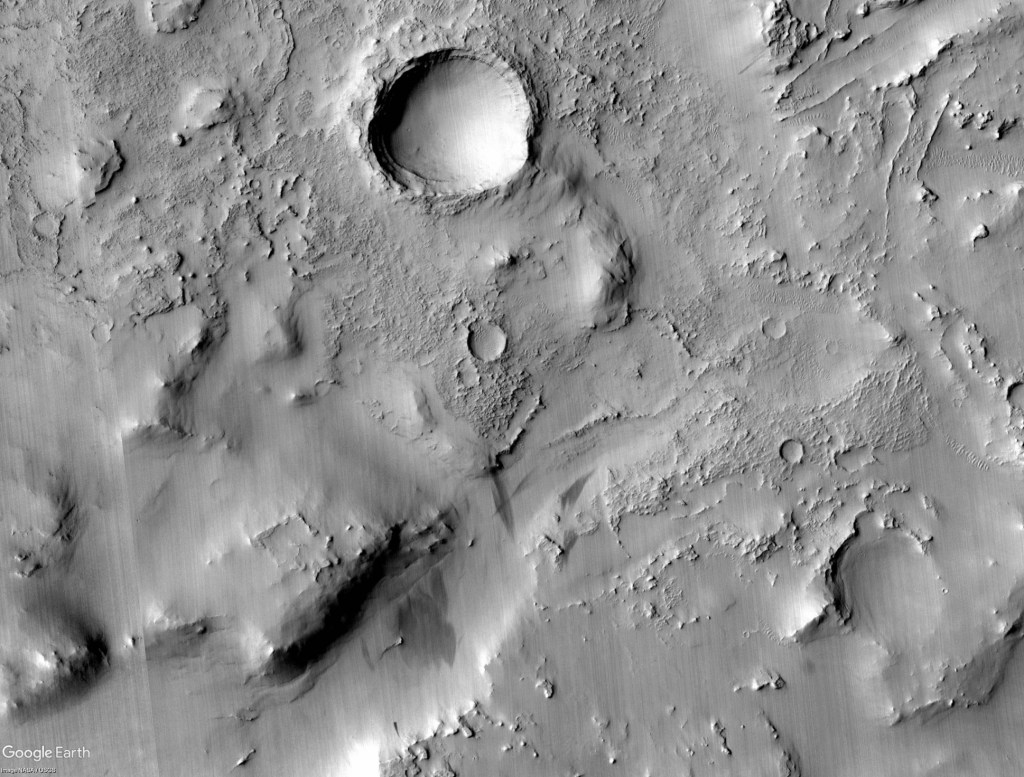
This area is near the southern rim of a crater. Perhaps even more interesting than the square formation are the bizarre looking surface features in the crater floor.

Craters in the Arabia Terra region of Mars have a complex origin, resulting from both impact events and volcanic and hydrothermal processes. Some craters show evidence of being filled by ancient lakes, fed by groundwater, while others are suspected to be explosive volcanic calderas, with layered deposits thinning away from their rims. Many craters also contain layered deposits from windblown dust and volcanic ash.
Other Views

What is interesting is that at low elevation angles, surface features in several areas in the crater floor look artificial even though they are probably natural.

Take Away
It is important to consider imaging geometry when interpreting satellite images. A square structure on the ground looks like a square when it is viewed from directly overhead. However, viewing the object from the side, at a lower elevation angle distorts its true shape.
Carl Sagan was famous for his quote “Extraordinary claims require extraordinary evidence,” When it comes to imagery it means taking into account the imaging geometry and correcting for geometrical distortions. This was how we were able to refute NASA’s claim that the 1998 image of the Face on Mars was not artificial because it was distorted. Those who doubt this fact have only to look at the geometrically corrected imagery in Google Mars to see for themselves.
Future articles will explore other aspects of the problem of assessing the artificiality of structures on Mars, and on the Moon.
 markcarlotto.com
Leave a comment