
Dogtown Commons was one of Gloucester’s first settlements. In the middle of Cape Ann, with the rise of maritime trades after the Revolutionary War, the Commons was abandoned becoming the place we now call Dogtown. Other than a few artifacts recovered by amateur archaeologists and would-be treasure hunters, the old roads, stone walls, and cellar holes of Dogtown are all that remain of one of the earliest chapters in Gloucester’s history. This article is the third of three that discuss what happened to three homes dating back to the original settlement that were important places in the history and literature of Dogtown.

Common Road, one of Cape Ann’s oldest roads, begins at Washington Street and continues across the Cape into Rockport. Today, the section between the large rock with the inscription “29” at the west side of the Goose Cove Reservoir and its continuation east of the service road on the other side of the reservoir is underwater. Before the reservoir was built in the 1960s, Common Road had crossed what was then a marsh. On the other side, two homes once stood, one on the right just past the marsh and the other up the hill to the left.
In his Cape Ann Tourist’s Guide Roger Babson tells us the location of the second house: “On the left beyond the brook are two cellars (R) and (T) close together, one marking the home of James Marsh. One hundred years later these houses were occupied by Liz Tucker and Judy Rhines…” Although Babson states the original owner was James Marsh, more recent research suggests that William Hilton, who was Liz Tucker’s father, built the house sometime in the early 1700s.
Elizabeth (Liz) Tucker was the great-granddaughter of Thomas Riggs who was the Town Clerk of Gloucester for 51 years, a selectman for 20 years, a schoolmaster, and a Representative to the General Court in 1700. His house on Vine Street in Riverdale is the oldest surviving house on Cape Ann. A parcel slightly greater than 4 acres taken by eminent domain from John Morse in the early 1960s could have been from one of the 1688 land grants. As shown below, house 39 from Josiah Batchelder’s 1741 First Parish map aligns with this parcel.

At first, it is not clear why Hilton’s daughter took her mother’s surname. But then we learn from genealogy data that Liz married her cousin, Joseph Tucker.
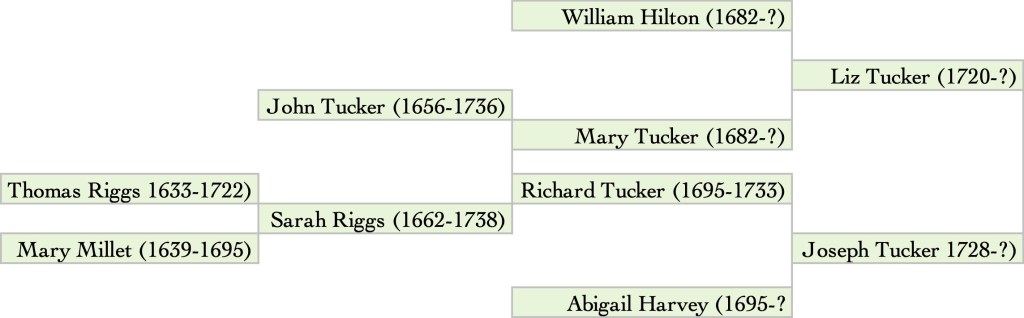
Charles Mann tells us in The Story of Dogtown that Liz Tucker and her niece, Judith Ryon, a.k.a. Judy Rhines later lived here together, probably after Joseph Tucker died. Judy was baptized in Sandy Bay on December 30, 1771, and so would have been about fifty years younger than Liz. Although we do not know exactly when she died, according to Mann, Judy was still alive in 1830. After Liz passed away, Neil Finson, moved into the house. Soon after the walls of the house collapsed and Neil moved into the cellar. He was the last person to live in Dogtown, dying in a Gloucester poorhouse in the winter of 1830.
According to Bill Noble, a lifelong resident of Riverdale, who knew Dogtown well as a boy, the Tucker/Rhines cellar is likely under a pile of boulders near the intersection of the service road and Common Road on the east side of the reservoir.

The Carter and Clark cellars are gone but the Tucker/Rhines cellar, which was probably bulldozed when the Goose Cove Reservoir was built, could still be there, in part, buried under rocks and trees waiting to be rediscovered.
The photo at the top of the article was taken before the Goose Cove Reservoir was constructed. The view looking west is from the Davis cellar in the direction of the Tucker/Rhines cellar. (Photo courtesy Bill Noble)
 markcarlotto.com
Leave a comment