
Dogtown Commons was one of Gloucester’s first settlements. In the middle of Cape Ann, with the rise of maritime trades after the Revolutionary War, the Commons was abandoned becoming the place we now call Dogtown. Other than a few artifacts recovered by amateur archaeologists and would-be treasure hunters, the old roads, stone walls, and cellar holes of Dogtown are all that remain of one of the earliest chapters in Gloucester’s history. This article is the first of three that discuss what happened to three homes dating back to the original settlement that were important places in the history and literature of Dogtown.

Although there are no photos or sketches of Carter’s house it may have been like the two-story house in Riverdale at the end of Gee Avenue known as “The Castle” that was built by Anthony Bennett sometime between 1688 and 1691. (Bill Noble)
Not to be confused with Morgan Stanwood, who lived at “29” or Nehemiah Stanwood, who lived at “S”, the house located at “15” on Roger Babson’s map of Dogtown was probably built by James Stanwood sometime after his father John had received a land grant from the town of Gloucester in 1688. From genealogy records, we know that James married Mary Davis, and had a daughter Mary born in 1719. According to research by Riverdale resident Tristram Griffin, later occupants of the Stanwood house included Joseph Clark Jr., son of Joseph Clark Sr., who lived down the road at “9” and Isaac Davis, who married Stanwood’s daughter. They, in turn, had a daughter Mary Davis, who was born in 1745.
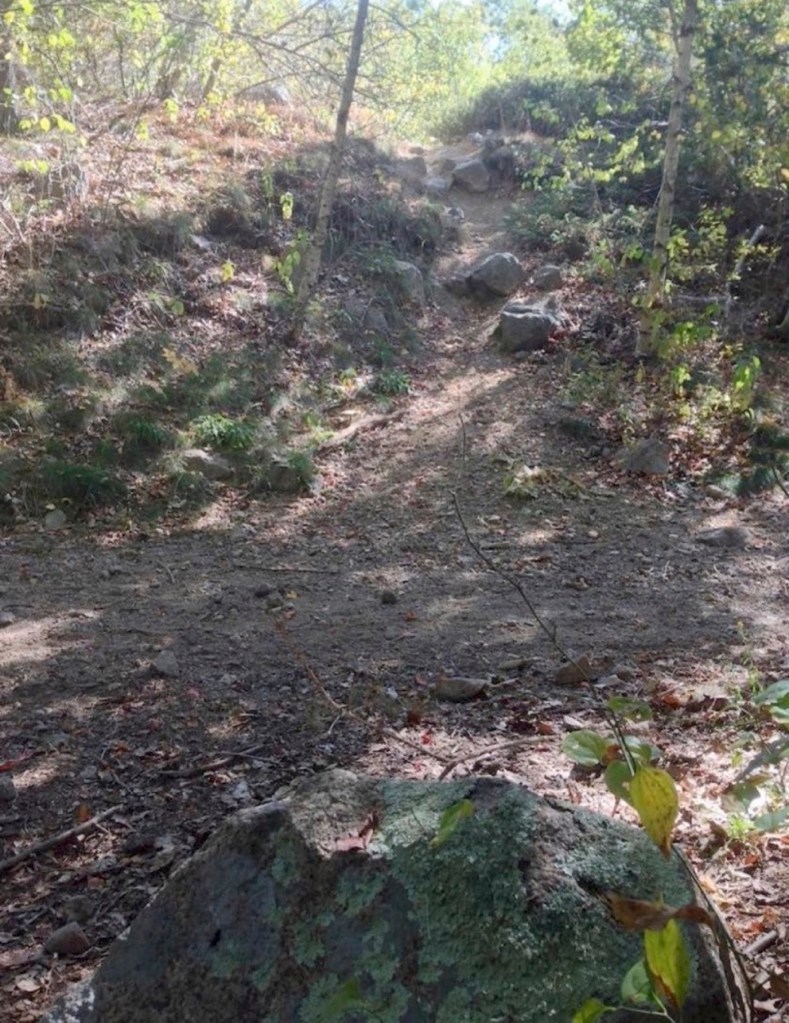
A stone marker with the number “15” is on the left across the road from a house that was once up this hill on the south side of Dogtown Road.
In The Story of Dogtown, Charles Mann tells us that this was the only two-story house in Dogtown. It is likely Joseph Clark Jr. lived upstairs from James and Mary Stanwood until his death in 1739. When Stanwood’s daughter Mary married Isaac Davis, they too probably lived there for a while before moving downstairs after Mary’s parents passed away. The next known resident was Easter Carter, who was living in Lanesville prior to moving to Dogtown. She either purchased the house or rented it from the Davis family. During this time the second floor was said to have been occupied by “Old Ruth” also known as John Woodman, a freed slave who built many of the stone walls in the area.
Little is known about the house between the mid-1700s and the early 1800s. This is a particularly interesting period in Gloucester’s history when those living in the middle of the Cape began to move to the harbor. Some have speculated that it is possible the change over from owners to renters might have had something to do with the beginning of the slow decline of this part of town over the next half-century.
After Easter Carter’s death sometime after 1833, Becky Smith, who was living at “2” on the Back Road (today’s Cherry Street), moved in. After she died, her daughter Rachel Smith became the last known occupant. Babson notes in his Cape Ann Tourist’s Guide that by this time the house had become a gathering place that “didn’t have a good reputation among the conservative parents of Gloucester.”
3-D views of the hill on which the Stanwood house once stood. The hill was used as a source of sand and gravel to improve Dogtown Road during the 1930s.
Archaeological excavations at several cellars in Dogtown have revealed a great deal about the people who lived there, e.g., what sort of items they owned, whether were they rich or poor, etc. We may never more about the inhabitants of the Stanwood house who were among some of Dogtown’s most famous characters as the land on which it stood is gone.
The next article discusses the Clark House.
The map at the top of the article is from Charles Mann’s The Story of Dogtown.
 markcarlotto.com
Leave a comment