
Previous groups such as the Dogtown Advisory Committee and Friends of Dogtown offered visions for the future of Dogtown. Disagreements and misunderstandings leading up to the failed 2019 National Registry nomination have resulted in what some perceive as a current lack of vision for Dogtown. Lacking a clear vision, many are worried that Dogtown could one day be turned into a state park or developed in some way.
What is Dogtown?
The place we call Dogtown can be defined in different ways. In terms of land use and ownership, the Babson and Goose Cove reservoirs and their watersheds comprise about 75% of the area of what can be called historical Dogtown – the part of Dogtown that contains cellar holes, Babson Boulders, and other features of historical significance. The other 25% of the area lies between the two watersheds and includes land along Dogtown Road north to Common Road and woodlots north of Common Road to just beyond Whale’s Jaw.
Self-Help Program
Like the two reservoirs and surrounding watersheds, the City of Gloucester owns most of the land in between. In 1984 this land was taken by eminent domain with compensation provided under the State of Massachusetts’s Self-Help Program. These parcels are currently protected under Article 97 which states:
The PARTICIPANT acknowledges Article 97 of the Massachusetts Constitution which states in part that: ‘Lands and easements taken or acquired for such purposes shall not be used for other purposes or otherwise disposed of except by laws enacted by a two thirds vote, taken by yeas and nays, of each branch of the general court.’ The PARTICIPANT hereby agrees that any property or facilities comprising the PROJECT will not be used for purposes other than those stipulated herein or otherwise disposed of, unless the PARTICIPANT receives the appropriate authorization for the General Court, the approval of the Secretary of Environmental Affairs, and any authorization required under provisions of Mass. G.L. c. 41, s. 15A.
The PARTICIPANT is the City of Gloucester and the PROJECT was the acquisition of 127.6 acres of land in Dogtown Common by the Gloucester Conservation Commission. At first glance, this would seem to provide some level of protection for these parcels until we go on to read the next paragraph:
The PARTICIPANT further agrees that despite any such authorization nd approval, in the event that the property or facilitates comprising the PROJECT are used for purposes other than those described herein, the PARTICIPANT shall provide other property and facilities of equal value and utility to be available to the general public for conservation and recreational purposes provided the equal value and utility and the proposed use of said property and facilities is specifically agreed to by the Secretary of Environmental Affairs.
Cause for Concern?
Herein lies some concern. It is not impossible to imagine a scenario in which the City might one day decide to develop this land effectively splitting Dogtown in two. Their reasoning might be something like this – since the land, which is not watershed, is not of sufficient value to the City as is, why not swap the parcels along Dogtown Road that are developable for an area of equal size somewhere else in Gloucester that is not? Nothing under Article 97 would prevent that from happening.
In the Self-Help program application form, the City states that “Deed and conservation restrictions will be determined on completion of the title and deed research.” It is interesting that no protections other than that provided by Article 97 were ever added by the City.
Under the current limited conservation restrictions, the City has used one of the parcels as a compost facility for almost four decades. One of the goals of the Dogtown Preservation Commission is to develop a plan to outsource the operation of the facility so that the site can eventually be closed and the land remediated. Many have come to rely on this as a place to drop off leaves and brush and do not want the City to close down the facility.
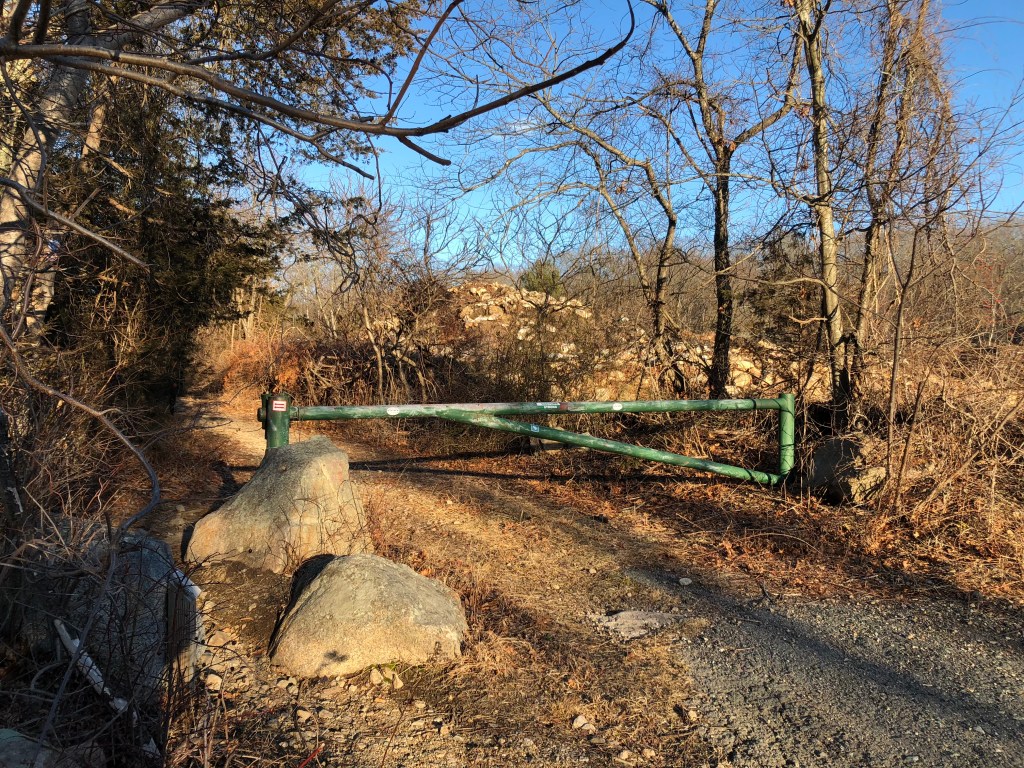
What is important to understand is that as long as the City uses this land as a compost facility it can just as well opt to develop it. That the City has not added more restrictive conservation measures to these parcels suggests that they may be leaving their options open.
To Learn More
Gloucester’s Self Help program application:
Gloucester’s Self Help program agreement:
The author wishes to thank Noel Mann for her many years of research into the Self Help program.

 markcarlotto.com
Leave a comment