
(This article is from Chapter 8 in my book The Cydonia Controversy.)
In the Pacific time zone, it is just after midnight on April 6, 1998. Mars Global Surveyor has just passed over Mars’ north pole and is heading south. Just before reaching periapsis — the point of closest approach to the surface — the spacecraft rotates slightly toward Cydonia and the Face. At 12:39 AM, the camera is switched on. As the craft flies over the Martian surface, an image 4.5 km wide by 42 km long is formed and stored in an onboard computer.
Most of the time, I telecommute by way of the Internet between my home, north of Boston, and my corporate office in northern Virginia. But today on April 6, I am up at dawn to fly to Washington DC for a series of meetings over the next couple of days. By the time I arrive at my office mid-morning, MGS has already begun to transmit the picture of Cydonia by way of NASA’s Deep Space Network to JPL.

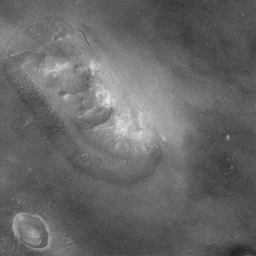

Between meetings, I nervously check the MGS website. Just after lunch, the raw unprocessed image of Cydonia is posted. Heart racing, I begin to download the data. After getting most of it, about 9 megabytes, my computer runs out of memory. Freeing up some space, I try again and finally get the image. By this time, several others in the office have gathered around. As the image comes up on the screen, all we see is a pattern of vertical stripes. Being a raw, unprocessed image, I realize the stripes are caused by gain variations across the camera’s photodetector array, and quickly write a de-striping program. By mid-afternoon, the image has been cleaned up and contrast-stretched.
A colleague of mine casually walks by and asks, “Where’s the Face?” Because of the extreme viewing geometry and the unusual direction of illumination, it is not immediately apparent. But as I stared at the image, I realized my prediction from the preceding week did match its general appearance. Being lit from below, the effect was like holding a flashlight under your chin. The impression was completely different from the Viking images. Where the Viking images were taken almost directly overhead late in the afternoon during the Martian summer, the new MGS image was taken mid-morning during the Martian winter with the spacecraft viewing the western side of the Face from a point 45 degrees above the horizon. The new image was significantly different in appearance. It was obvious that the Face if it was in fact intended to represent a face, was severely eroded. Maybe it was a geological formation after all. Still, there was much about it that was unusual.
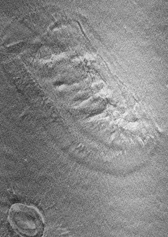
When I got back to my hotel room that night, there was a message from John Brandenburg and Vince DiPietro, “Call us. We are puzzled and going to get drunk.” Turning on the evening news I understood why. A few hours after the MGS image was received, JPL’s Mission Image Processing Laboratory posted a “contrast-enhanced” version of the Face. Although image enhancement is supposed to improve the visual quality of a picture, JPL’s enhancement made it look worse — the Face looked like scratches in the sand. This image, which Mars researcher Lan Fleming calls the “catbox” image, appeared on the news that night.
As promised, JPL made no official comment. They didn’t have to. Their picture said it all. No one, not even I, could see a face in their enhancement. Was it simply a bad job, done in haste to get a quick picture out to the public and the media, or a clever move by certain individuals to put the matter to rest once and for all?

We all wanted the matter to be resolved, but not by the media in a few hours on the evening news. McDaniel seemed to see it coming. Again, from a posting on his website the week before,
It is my personal view that the problematic way NASA has treated this subject in the past is the result of certain unfortunate moves made early on in the history of this debate, again because of premature conclusions and only cursory analysis of the data. We urge NASA scientists, as well as members of the public who may attempt analysis and interpretation of the data, to view the data objectively and with care, avoiding premature conclusions. The stakes are too high to allow bias or a desire to be first to obscure the truth that may eventually emerge from the data provided by the Surveyor.
Clearly, over the years, planetary scientists had become irritated by the Cydonia controversy — a debate they felt had gone on for too long. Shortly after the MGS image of the Face was released, geologist Michael Carr expressed their sentiment, “I hope we’ve scotched this thing for good.”
It seemed as if they had.
 markcarlotto.com
Leave a comment