
The two Viking orbiters aboard spacecraft sent to Mars in 1975 were retired in 1978 and 1980 several years before DiPietro and Molenaar rediscovered the Face in the NASA archives. Other than the Soviet Union’s Phobos 2 probe to one of its tiny moons, follow-up imaging of the planet itself had to wait twelve years for the next mission, the Mars Observer, launched in 1992. Unfortunately, an explosion aboard the spacecraft ended the mission just before orbital insertion the following year. Five years later, in the fall of 1997, Mars Global Surveyor reached the Red Planet and began a series of aerobraking maneuvers designed to place it into the proper orbit.
Over the long hiatus, the developer of the Mars Observer Camera (MOC), Michael Malin, became highly critical of the independent Mars investigation. With the development and operation of the MOC outsourced to his company, Malin Space Science Systems, there was some concern that the Face and other objects under investigation would not be targeted.
On November 20, 1997, Vincent DiPietro, John Brandenburg, Horace Crater, David Webb, Stanley McDaniel and I met with Carl Pilcher, the Acting Director of Solar System Studies and Joseph Boyce at NASA headquarters. The purpose of the meeting was to introduce our independent research group, the Society for Planetary SETI Research (SPSR), and to present preliminary findings in the hope of getting NASA leadership to commit to re-imaging these objects. The hour-long meeting, which had been arranged by Brandenburg and McDaniel achieved its goal. In Webb’s words:
Pilcher firmly and unequivocally stated that it was the official policy of his department and of NASA that the Cydonia region was to be imaged at high resolution during fly-over and that Glenn Cunningham and Mike Malin were aware of, and had signed off on the policy… He went on to say that everyone was interested in having the area imaged: one group because they wanted to show us how wrong we are and have been all along; the other group, because they feel that we have some interesting material, and they would like to see just how interesting it turns out to be.
On March 26, 1998, McDaniel received a telephone call from Cunningham, who was the MGS Project Manager, informing him that the spacecraft would come out of aerobraking that evening and enter the science phasing orbit. A few days later, McDaniel and I met with Glenn Cunningham and Arden Albee at JPL to discuss their plans for imaging and data release. We learned that the pictures would be taken in the morning on April 5. That the sun would be higher in the sky than it was in the Viking images led us to voice our concern that this could reduce contrast and shadowing, making the imagery harder to interpret. But assuming a good picture of the Face, or another one of the features of interest, was obtained, we were curious about how JPL would handle three possible outcomes: 1) obviously artificial, 2) obviously natural, or 3) not sure. They said the plan was to simply release the data and say nothing, letting the picture speak for itself. JPL would stay out of the controversy.
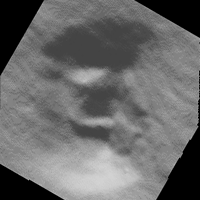
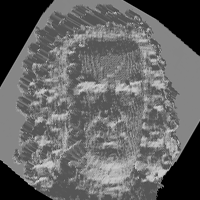
Several days after our meeting at JPL, I generated a prediction of how the Face might appear based on an estimate of the MGS imaging geometry, generated by Mars researcher Peter Nerbun. In 1988, as part of my shape-from-shading analysis, I computed synthetic images of how the Face appears under different lighting conditions. The images showed that under certain conditions, particularly those with the sun high in the sky (late morning to early afternoon), the impression of a face was not very distinct. According to Peter’s model, the sun would be illuminating the face from below. As it turned out, this was just about the worst of all possible lighting geometries.
After waiting for more than twenty years for new images of Cydonia, that the lighting conditions were not going to be ideal seemed relatively unimportant at the time. With the April 5 target date approaching, McDaniel warned on his website:
We have frequently stressed that it is not the position of SPSR scientists to advocate any particular outcome, but to go with the facts as they emerge. If the objects turn out to be clearly natural in origin, we will be among the first to say so. However, it is also important to avoid premature judgment based on initial impressions. It may take many months of study, augmented by data coming from the mapping mission later in 1999, before the true impact of the MGS mission on the question of the anomalies will be understood.
And so, what happened next, came as no surprise.
The image at the top of the article shows an object photographed on Mars’ tiny moon Phobos. (Courtesy NASA)
 markcarlotto.com
Leave a comment