In the previous article, Carl Sagan refers to the Face on Mars as a “blocky mesa” not unlike other landforms in the area. Following the publication of our shape from shading paper in Applied Optics, I set out to determine if the Face was just a natural formation or something else using a new algorithm and a new approach to planetary SETI.
In the mid-1980s, we began a series of research projects at TASC to develop algorithms for finding manmade objects in imagery – objects such as military vehicles, ships at sea, etc. Inspired by recent advances in computer graphics that used fractals to generate photorealistic natural backgrounds for scenes in movies like Star Trek II, one of my colleagues at TASC, Michael Stein, come up with the idea of reversing the process, of using fractals to analyze images.
Fractals are phenomena exhibiting the property of being self-similar – that a part of a fractal resembles the whole. The branches of a tree, the shape of clouds, and the structure of terrain surfaces are examples of fractals in nature.
Under certain conditions, images of fractals are also fractal. Mike developed an algorithm that tested images against a fractal model to find areas that are not fractal. Instead of using examples of the types of objects one wishes to find as is done using current machine learning convolutional neural network approaches, the fractal approach finds artificial objects by eliminating the parts of an image that are not fractal and hence not natural. An advantage of this type of approach is it can detect any kind of object, even those that you’ve never seen before.
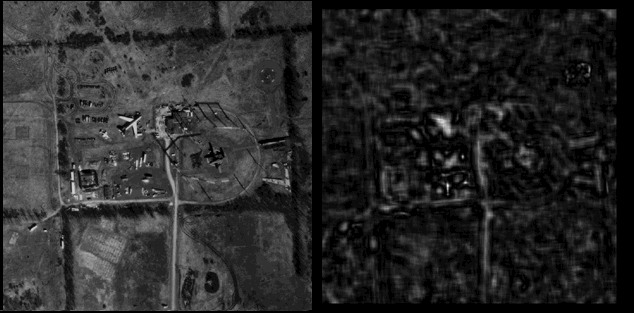
As with shape from shading, the fractal algorithm was developed at an opportune time. Applying it to the orbit 35 Viking frames revealed the Face to be among the least fractal (and hence least natural) structures in the area. Our findings were published in 1990 by the British Interplanetary Society.
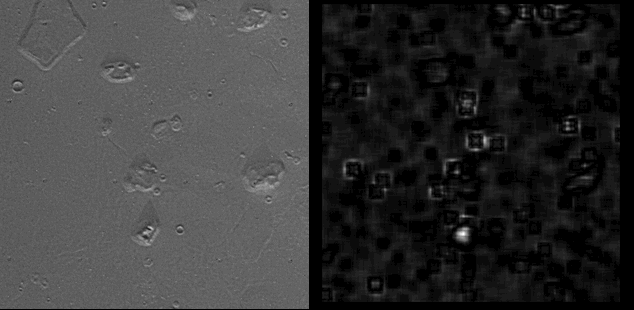
I sent Sagan a copy of our paper. In return, he sent a copy of a paper he had written on a method for searching for extraterrestrial intelligence by detecting deviations from black-body radiation curves – an approach remarkably similar to Mike’s method of detecting manmade objects by their deviation from a fractal model.

Only under certain conditions are images of fractals also fractal. A limitation of the fractal object detection algorithm noted in our paper is that it works best for images taken at low sun angles, that is, with the sun close to the horizon. While the face stands out as the least fractal structure in the Viking orbit 35 frames, the Face appears less remarkable in the orbit 70 frames taken at a high higher sun angle. The same is true for later Mars Global Surveyor and Mars Odyssey/Themis imagery.
In 2010, I developed a biologically-inspired algorithm that modeled and detected manmade objects as deviations from a statistical model of the image background. The algorithm, which was used to analyze a group of unusual objects discovered on the far side of the moon, will be discussed further in a future article. In preparing this update I decided to apply it to the higher sun angle MGS images over Cydonia shown below.
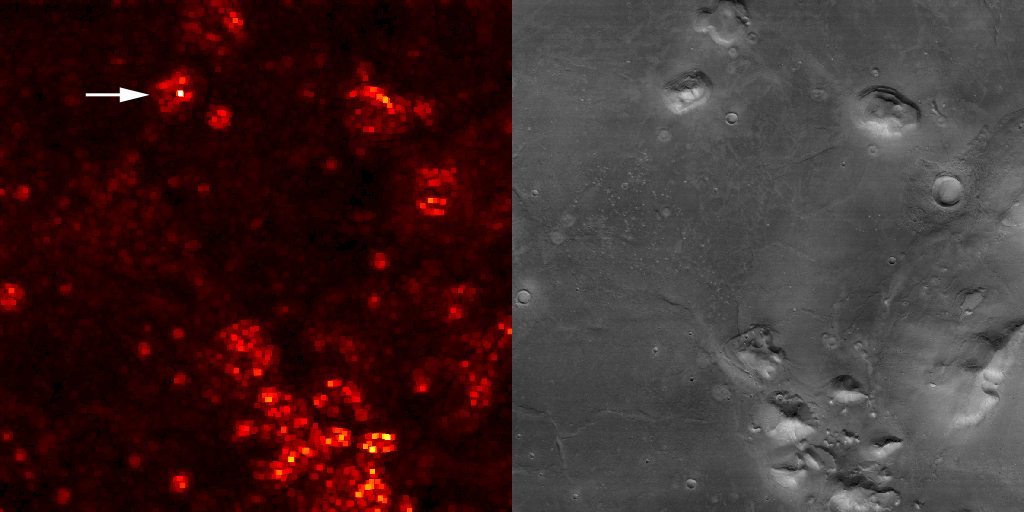
Like shape from shading, these results are not sufficient to prove the Face is artificial; however, taken together they indicate a pattern of converging evidence suggesting the Face and other nearby objects may not be natural but something else.
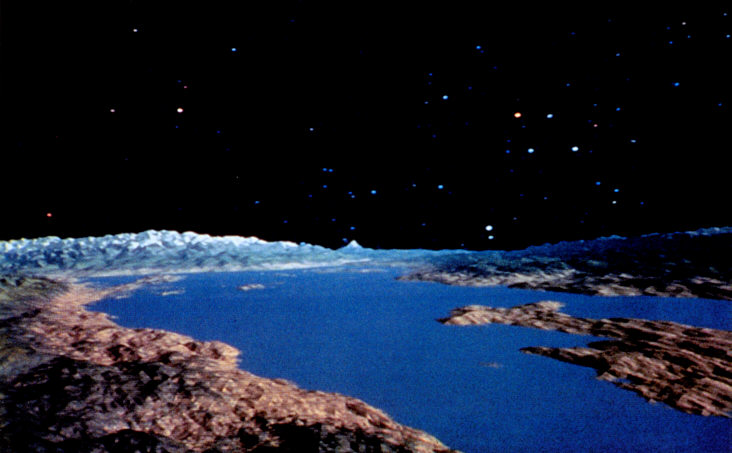
The image at the top of the article is from the Genesis sequence in the movie Star Trek II.
 markcarlotto.com
Leave a comment