
From the beginning, the mainstream scientific community led by NASA/JPL stated with certainty the Face on Mars was “a trick of light and shadow” – an optical illusion. Their position was never challenged because a second image over the same area showed nothing unusual, at least according to NASA/JPL. But few actually saw that image until Vince DiPietro and Greg Molenaar found it a few years later in the NASA archives.
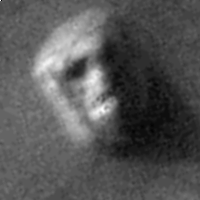
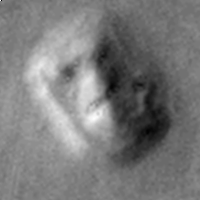
Around the time I learned about the Face on Mars and the Independent Mars Investigation (later known as the Mars Project), a group of us at TASC were evaluating recent developments in artificial intelligence (AI) research for one of our clients who was interested in extracting 3D information from imagery. One of my first projects at TASC was to detect vertical objects based on cast shadows. The state of the art at that time involved using photogrammetric techniques to compute height maps from stereo pairs – two images taken from different perspectives by exploiting parallax differences. We were examining a new method known as shape from shading (SFS) that could do the same using only one image.

A student from MIT’s AI lab implemented an SFS algorithm as part of a summer internship at TASC. Testing the algorithm revealed a limitation – that the scene had to be composed of the same type of material or at least materials having similar surface reflectance properties for it to work. This is a problem in images of terrestrial scenes having a diversity of materials (water, vegetation, soils, manmade materials, etc.) with different surface properties. The Moon and Mars are much more uniform in terms of their reflectance properties so I decided to try SFS on one of the Viking images of the Face. The algorithm generated a 3D model that captured a facial form, but was it accurate?
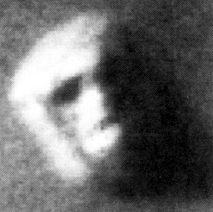

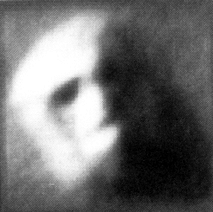
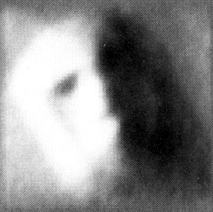
Since we didn’t have “ground truth” – we didn’t know the actual shape of the landform, there didn’t seem to be a way to measure the accuracy of the computed model. One of my colleagues, Brian O’Leary, an ex-Apollo astronaut and one of the original members of the Independent Mars Investigation, did his doctoral dissertation on an almost identical method known in the planetary science community as photoclinometry. Brian suggested we use 70A13, the other image of the Face found by DiPetro and Molenaar taken under different lighting conditions as a test. The idea was to compare the image of the Face in 70A13 to a computer generated image (CGI) based on the model derived from 35A72 and rendered with the 70A13 lighting conditions, and vice versa. The results were almost identical thus validating the accuracy of the method.
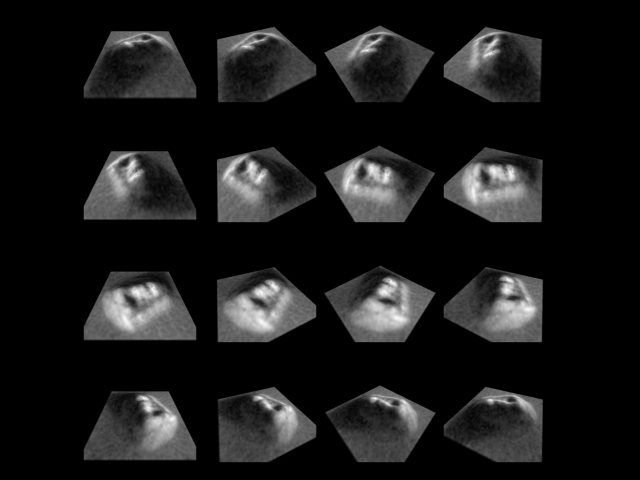
Optical illusions generally fall apart when you change the viewpoint or the lighting. We used TASC’s Pixar image computer, which was developed by Lucasfilm for high-end commercial and scientific applications, to create a sequence of CGIs of what the Face would look like under different simulated conditions. Finding that the Face retained its appearance over a wide range of viewing and lighting geometries suggested it is not a trick of light and shadow as NASA had claimed.
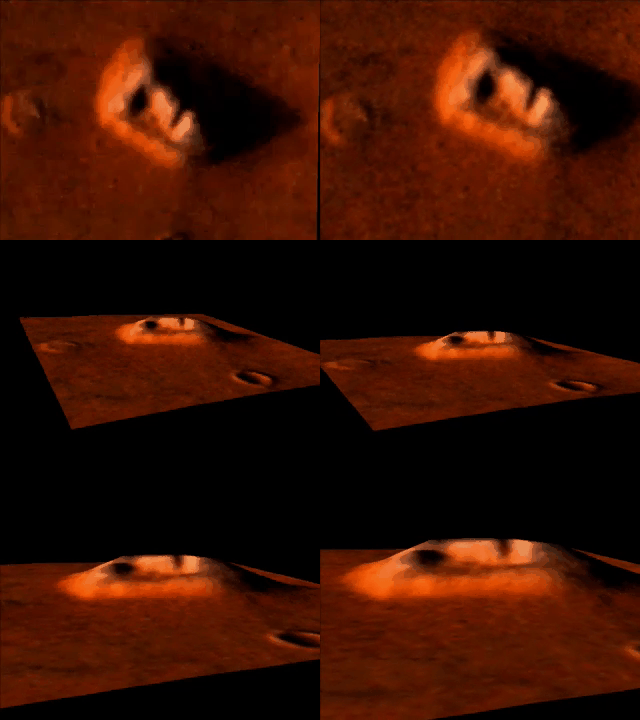
Our findings were published in the May 15, 1988 issue of the journal Applied Optics. (O’Leary published similar results in the May 1990 issue of the Journal of the British Interplanetary Society.) Yet, despite publication in peer-reviewed journals, mainstream scientists continue to dismiss the Face as nothing more than a strange-looking but completely natural geological formation. (Stanley McDaniel examines the anatomy of this apparent denial of our findings by the planetary science community in his book The McDaniel Report.)
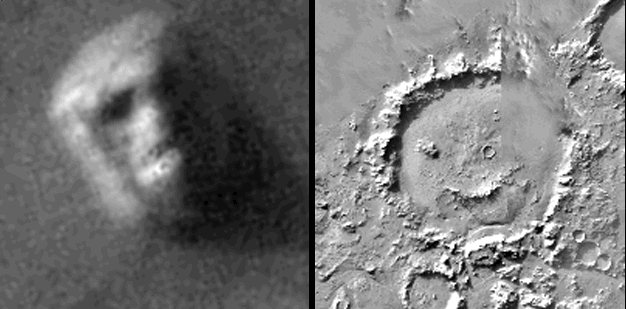
Publicly, Carl Sagan was one of the most vocal critics of the claim that the City, Face and other nearby objects were artificial structures. But privately, he was curious about our findings. In the next article, I share my seven-year-long correspondence with Dr. Sagan regarding the Face on Mars.
 markcarlotto.com
Leave a comment