
The possibility that objects of extraterrestrial origin might be found on places like the far side of the moon was first proposed by Carl Sagan in the early 1960s. Although a number of independent investigators claim to have discovered such objects on the near side of the moon in Lunar Orbiter and Apollo photographs in the late 1960s, a collection of objects on Mars imaged by a Viking Orbiter spacecraft in 1976 has become the most famous. Among these objects is the “Face” – a rock formation resembling an enormous humanoid face (about 2.5 km long x 2.0 km wide x 0.4 km high) staring up into space from the surface in a region of Mars known as Cydonia.
Rather than being heralded as the first possible discovery of life beyond Earth, the Face was dismissed by scientists at the Jet Propulsion Laboratory (JPL) as a trick of light and shadow, an optical illusion. According to NASA and JPL, the impression of a face was gone in a second image taken on a later orbit. Several years later, the image (Viking orbiter frame 35A72) was rediscovered by Vincent DiPietro and Gregory Molenaar, two engineers at NASA’s Goddard Spaceflight Center. Remarkably, they also found the second image (70A13) containing the Face under slightly different illumination with the sun about 20 deg. higher in the sky. To their surprise, the Face was still there.
Image Processing and Enhancement of Fine Structure in the Face
I became involved in 1985 after reading about a group known as the Independent Mars Investigation. My initial interest was in applying image processing techniques we had developed at TASC, a tech company north of Boston, to the Viking imagery. After receiving copies of the Viking orbiter data tapes from JPL I got to work to first clean up the raw imagery, to remove the “salt-and-pepper” noise caused by data transmission errors.

A 3×3 pixel Laplacian filter was used to detect outliers (pixels whose values differ from the local mean by more than a specified threshold). These pixel values were then replaced by the local median value computed in a 3×3 window centered about the pixel. The local median maintains edge structure and better preserves subtle detail in noisy areas of the image. The threshold value was selected to reduce the magnitude of the noise without significantly distorting fine-scale detail in the image.
To help in visual interpretation, the imagery was enhanced using several techniques. Over large areas, a local contrast stretch algorithm was used to remove shading variations due to illumination and albedo variations across the imagery, and increase local contrast while maintaining overall tonal balance. Over small areas and for isolated features the contrast was enhanced using a simpler “clip-and-stretch” algorithm that assigns pixels below a low clip value to zero, pixels above a high clip value to 255, and pixels in between to the range 1-254. Two enhanced views of the Face are shown below from 35A72 (left) and 70A13 (right) after noise removal and clip and stretch. The images were magnified using a cubic spline technique, which uses the values of pixels in a 5×5 window to interpolate intermediate pixel locations.


Beyond the general impression of a human (or more generally, primate) face, a number of subtle features or embellishments can also be seen. They include several thin lines above the eyes, broad stripes across the face, and fine structures in the mouth that appear to some as teeth. Each is illustrated below.

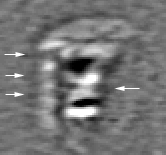
The lateral stripes are enhanced by horizontal averaging in a rotated version of 35A72 (above right). The stripes are not in the same direction as sensor scan lines. They do not show up as well in the higher sun angle Viking frame 70A13, suggesting they may be the result of topographic variations, which are more evident at lower sun angles, rather than differences in albedo. Several crossed lines in the forehead area (above left) are also evident. These lines are also visible in 70A13, which increases the likelihood that they are real features and not sensor artifacts.
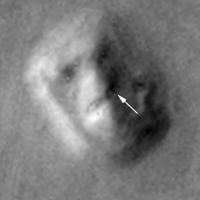
Fine-scale structure in the mouth that look like teeth is also evident. Like the cross lines seen in the previous figure, these features (shown below) cannot be dismissed as noise in the imagery or artifacts of the processing since they appear in both 35A72 and 70A13 taken about 35 days apart.


The figure below (right) is the result of adding the two images in the previous figure and dividing by two in order to emphasize features present in both images. Michael Malin, the developer of the Mars Observer camera (to be discussed in a subsequent article), suggested the “teeth” were nothing more than noise emphasized through the improper use/interpretation of image enhancement techniques. However as noted in the McDaniel Report, the features identified by Malin shown in the figure below (left) are not the features seen here. Malin’s are on the right shadowed side of the Face and are present in only one of the two images.

Other Objects
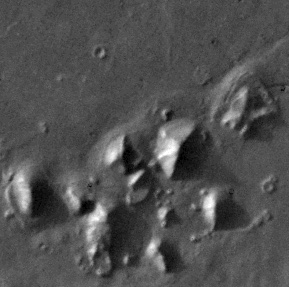
Although one could dismiss a single object as an optical illusion, the presence of other nearby features that are quite unusual themselves is harder to ignore. About 14 km west-southwest of the Face is a collection of unusual-looking landforms dubbed the “City” by author Richard Hoagland. Where the Face is a rounded formation, classified geologically as a mesa or knob, the City is composed of a number of pyramidal structures with angular sides.

Perhaps the most unusual in the City is a structure known as the “Fort” – the object closest to the Face in the above perspective view. The figure below shows the Fort in the original Viking image (left) and from the southwest (right) in a computer-generated perspective rendering. Fine-scale details include a regular pattern of indentations or crenelations (a term used by Sagan) along the lower wall of the structure and linear features in the terrain to the right.
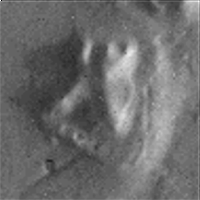
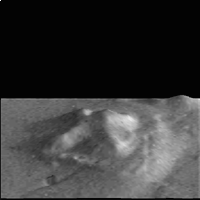
As shown below, its similarity to another structure in the City (left), an object to the southwest known as the Starfish pyramid, suggests the possibility it could have once been a pyramidal object that collapsed revealing an inner space (right).

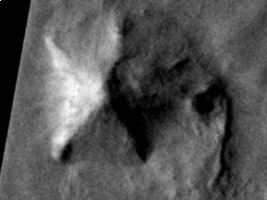
About 21 km south-southwest of the Face and 18 km due south of the city is a much large pyramidal structure discovered by DiPietro and Molenaar known as the D&M pyramid. As shown in the figure below, the original Viking image (left) and a computer-generated rendering looking north (right) show a five-sided landform where one of the sides is partially shadowed and two of the sides appear to have collapsed. The south side has a smooth triangular face oriented almost exactly due south. In his analysis of the D&M, a geologist with the Defense Mapping Agency, Erol Torun, was unable to come up with any natural process or combination of processes to account for its origin.

I presented this work on Sci-Fi Channel’s Inside Space, a popular science series hosted by Nichelle Nichols, who played Uhura in the 1960s TV series Star Trek.
In the next article, we test NASA’s claim that the Face on Mars is “a trick of light and shadow” using a new method developed at the time known as shape from shading.
 markcarlotto.com
Leave a comment